B2B Revenue Operations: the problem is not bad data, it is the absence of an owner
Why buying tools or hiring more people amplifies the problem when no one answers for the connection between Marketing, CRM, and Sales.
Read articleRevOps
A B2B company needs Revenue Operations (RevOps) when it generates leads every month, but cannot tell which ones saw an opportunity, a sale, and revenue. When Marketing, Sales, and the board disagree on where the funnel is losing efficiency. RevOps connects acquisition, qualification, CRM, and sales in a single revenue system. Before investing more in media or switching suppliers, it’s worth understanding where that connection breaks down.
To understand your case, do the Radar de Growth. It only takes 4 steps and you can get an initial reading quickly. If you already know what you need to decide and prioritize, check out the Growth Audit.
Definition
Revenue Operations (RevOps) é a disciplina que alinha aquisição, qualificação, CRM, vendas, Customer Success e dados para que a receita seja previsível e replicável. Não é uma ferramenta nem um relatório: é o desenho de como lead, oportunidade, venda e renovação são definidos, registrados e medidos entre as áreas. Em empresas B2B, isso envolve Marketing, Vendas, Customer Success e dados trabalhando com as mesmas definições.
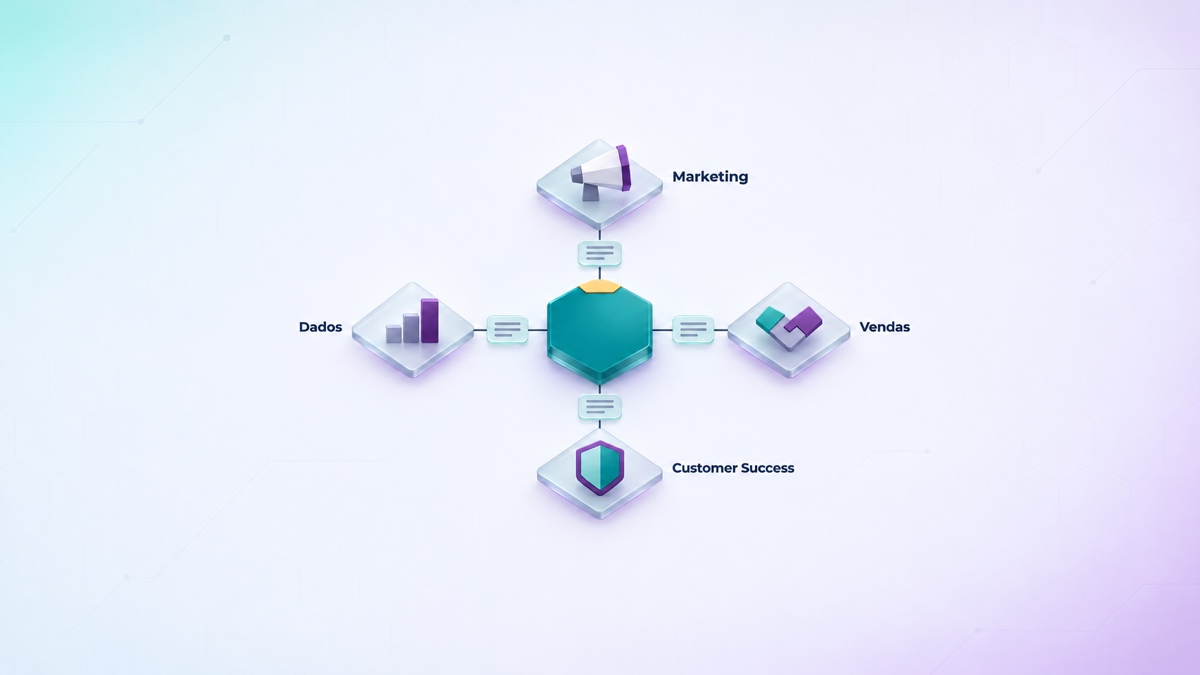
In practice, RevOps answers questions that seem simple and rarely have a single answer within the company:
When each area responds with its own definition, each report tells a different story. The job of RevOps is to make those definitions exist, be valid for everyone, and appear in the CRM.
What RevOps is not: a CRM tool, a dashboard, or a project all at once. Tools and reports come later after the definitions are combined.
Dig deeper into the article CRM and RevOps for B2B.
Predictability
Predictable recipe This is the one where the pipeline can be estimated based on measured inputs, such as origin, stage, and the rate of passing between stages. Reproducible recipe It is the one whose path is described and works without relying on a person or a channel. RevOps takes care of the five connections that support this: acquisition, qualification, CRM, sales, and the return of revenue to acquisition.
O resultado volta e muda onde se investe
The five connections, each with the question it answers:
Predictable does not mean guaranteed. It means that the pipeline’s estimate is based on measured inputs, and that the error of that estimate can be read and corrected. Repeatable does not mean doing the same thing over and over again. It means that the path is described sufficiently well for another person, or another channel, to repeat it.
When the bottleneck is at connections 1 to 4, the work happens in acquisition structuring and pipeline.
Signs
The most common signs are: leads arriving without any origin and recorded stages. Marketing and Sales disagree on the quality of the lead. CRM that does not close the attribution of the lead that became an opportunity. The director requests more volume of leads. His pipeline is unclear about what to prioritize. The company changes traffic managers or tools without a change in finances. A single isolated sign may be punctual. Several together indicate a problem in the connections, not in a single channel.
Each signal can be observed without new tools.
When several of these signals appear at the same time, it is worth treating the connections before tampering with the channels.
The Radar de Growth organizes these signs into a maturity reading.
Assessment
The problem is traffic when few visitors arrive from the right profiles. It’s qualification when many leads enter, but few saw an opportunity. It’s CRM when there’s no reliable record of origin and stage to know where the funnel stalls. Starting with the connection where the lead stops moving prevents spending more on media to treat the symptom.
The table below is a simplification. The same symptom can have more than one cause; therefore, the reading begins with the connection where the lead stops moving forward.
| Symptoms | Possible connection | What to check first |
|---|---|---|
| Few visitors from the right profiles | Aquisition & Pipeline | Whether campaigns and content speak to the profile of the buyer and what sources bring that profile |
| Many leads and few opportunities | Qualification | If there is a written criteria for qualified leads and if Sales knows about it |
| Opportunities stalled or unanswered | The transition from marketing to sales | The deadline for the first response and who owns the lead |
| It is not known where the sale came from | your company | If origin and stage are recorded at the entry and preserved until closure |
| The result of sales does not change where the investment is made | Return of revenue from the acquisition | If the result by origin reaches those who decide the budget |
Use Radar de Growth to organize this reading.
Growth and RevOps
Growth focuses on generating and converting demand by testing channels, offers, and messages. RevOps It focuses on the connections that support this result: common definitions of lead and opportunity, CRM, the transition between Marketing and Sales, and revenue metrics. Growth without RevOps generates activity that is difficult to measure. RevOps without Growth organizes a process without new demand to fuel it.
| Criterion | Growth | RevOps |
|---|---|---|
| Focus | Generating and converting demand | Support connections between acquisition, CRM, sales, and revenue |
| Typical question | Which channel, offer or message brings more qualified demand? | What are lead, opportunity, and sales, and where are each of them recorded and measured? |
| When it's missing | There is a process, but little new demand | There is activity and leads, but little clarity about what turned into revenue |
At Degasperi Growth & Revenue, the two perspectives work together. Growth defines where to test. RevOps ensures that the test result is read in terms of revenue, and not just in terms of leads.
See the article Growth and RevOps Diagnosis: how to find the real revenue bottleneck.
Marketing and Sales
Marketing and Sales They now measure the same quality of leads when together defining the qualification criteria, the deadline for the first response, and the return on sales for each lead received. The result is a written agreement with the same steps in the funnel in both areas and the reason for loss recorded in the CRM, which allows for the acquisition to be adjusted based on revenue.
The agreement fits on one page and has five parts:
What matters is that both areas sign the agreement and that the CRM reflects it.
Dig deeper into the article B2B lead SLA: the invisible KPI that is destroying your conversion.
SaaS B2B
Em empresas B2B SaaS, Revenue Operations (RevOps) cuida do mesmo sistema de receita, com três diferenças: a receita é recorrente, então churn e expansão contam tanto quanto a venda nova; Customer Success entra no circuito, porque a promessa feita na venda afeta a renovação; e convivem leads de trial ou de produto com leads de vendas, que precisam de critérios de qualificação diferentes. Sem essa separação, o funil mistura sinais e a previsão de receita erra.
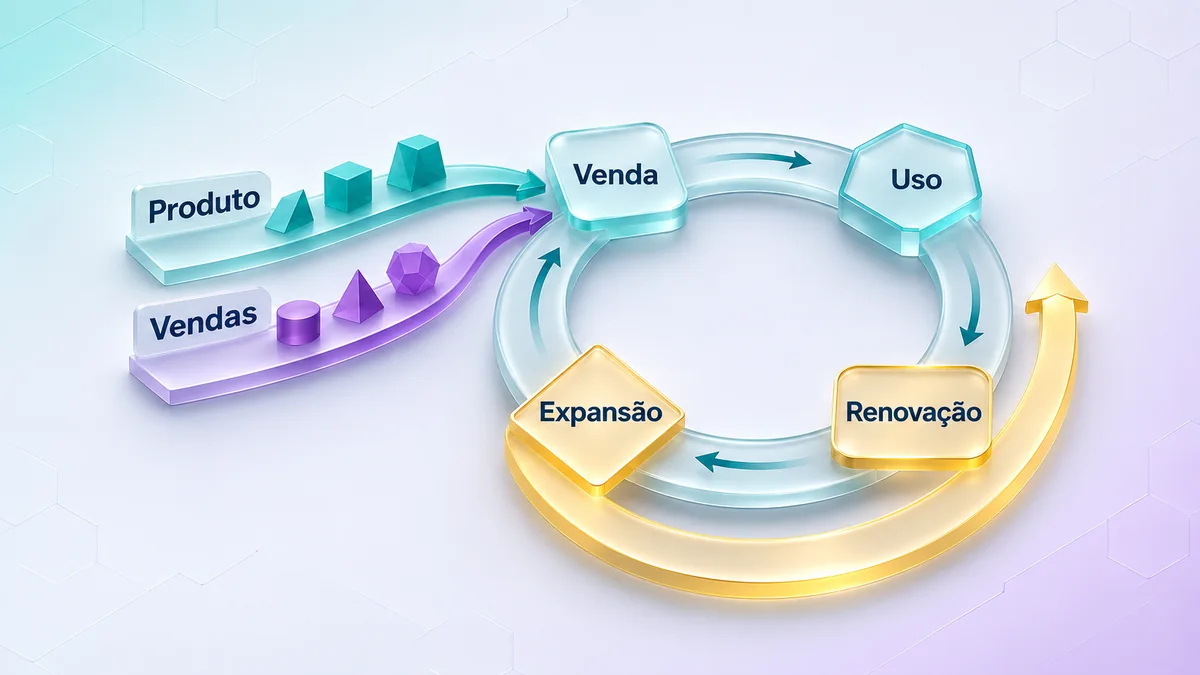
O que muda na prática em uma operação SaaS B2B:
Um exemplo. Em uma plataforma SaaS B2B de member get member, 97% dos leads gerados por mídia paga eram desqualificados. O CRM, ainda em implantação, não devolvia às campanhas quais leads viravam oportunidade. O trabalho redefiniu o perfil de cliente ideal a partir dos clientes que mais valiam a pena e passou a devolver o retorno de vendas à mídia. No período seguinte, o CAC caiu 40%, a passagem de MQL para SQL subiu 30% e a receita cresceu 30%. O ciclo de venda foi de 29 para 7 dias. A mudança alterou o que entrava no funil, e esses foram os indicadores do período, que também refletem o mercado e o time do cliente.
Quando o gargalo está entre o lead e a oportunidade, o Growth Audit mostra onde agir primeiro.
Diagnóstico de Presença em AI
Diagnóstico de Presença em AI It is the acquisition of demand mediated by AI responses, such as ChatGPT, Perplexity, Gemini, and Google AI Overviews. It enters the revenue system as another lead source and needs to close the cycle in the CRM: record when the contact declares to have learned about the company through AI, what question they asked, and what happened next. Without this record, visibility in AI does not turn into revenue learning.
To complete the cycle, the CRM needs to store five pieces of information:
Presence in AI Search measures visibility, that is, whether the brand appears in the responses. Revenue only appears when that record exists. Without it, the company knows that it appears, but it doesn’t know if it becomes a pipeline. AI responses change between queries and between tools. That’s why the reading is descriptive and repeated over time, and no page guarantees citation.
See how Degasperi Growth & Revenue evaluates it presence in AI Search.
Consulting or in-house team
The choice between consulting and in-house RevOps depends on four criteria: the urgency of the diagnosis, the ability to maintain the operation after the transition, the cost and timeframe for assembling a team, and the need for an external view of the funnel. Consulting usually serves to diagnose and prioritize. The in-house team usually serves to maintain the routine. In some cases, the two complement each other at different times.
| Criterion | Consulting tends to be useful when | The internal team tends to serve when |
|---|---|---|
| Urgency of the diagnosis | There is a decision to be made in a few weeks and an external reading is lacking | The urgency is less and the company can build the reading out gradually. |
| Keeping the operation going after | The routine already has a boss and lacks direction and priority | The routine requires daily monitoring of CRM, processes, and data |
| Cost and time to build a team | The deadline for hiring and training is longer than the deadline for the decision. | The company has a budget and a deadline to hire and keep the team. |
| External view | The funnel needs to be read by those who are not part of it. | The internal vision is already reliable and accepted by the areas |
Where Degasperi Growth & Revenue fits in: diagnosis, prioritization, and structuring of acquisitions and pipelines. When an internal team already exists, the consulting firm can support and train that team without taking on the day-to-day routine.
See the article Degasperi Growth & Revenue vs. competitors: how to choose the right growth consulting firm for your technology startup.
Limits
The Growth Audit não é indicado para empresas sem aquisição estruturada, sem investimento recorrente em aquisição ou sem time interno de marketing nem de vendas. Nesses casos, o primeiro passo é a Acquisition & Pipeline Design, que organiza a aquisição e o time. RevOps também ainda não é o passo certo quando a empresa não registra origem e etapa dos leads.
If your company is not at that point yet, the way to go is different: first structure the acquisition and the team, and only then read the connections.
The Radar de Growth it helps to see where your company is at. If you need guidance, the Revenue Growth Sessions They could be the solution.
WHAT'S NEXT
Those who still understand the problem can start with the Growth Radar, a maturity diagnosis in acquisition, CRM, pipeline, and revenue. Those who already know they need to decide and prioritize can request the Growth Diagnosis, which reads acquisition, CRM, and pipeline and delivers prioritized recommendations within 15 to 21 business days. Those who want specific guidance can use a 45-minute Growth Session.
| Your situation | WHAT'S NEXT | What it delivers |
|---|---|---|
| Still understanding the problem | Radar de Growth | Readiness reading in acquisition, CRM, pipeline and revenue |
| You want a personalized feedback from Radar | Growth Insights | Customized PDF report for your business and a video recorded by Israel of up to 15 minutes |
| You need to decide and prioritize | Growth Audit | Priority recommendations, within 15 to 21 working days |
| He wants punctual guidance | Revenue Growth Sessions | 45-minute sessions |
| Want to structure or organize acquisition and pipeline | Acquisition & Pipeline Design | Israel structures its acquisition and pipeline from scratch. Adjustments to connections 1 to 4 in the operation |
| Want to know how the brand appears in AI? | AI Search Audit | Readability, visibility, and authority in ChatGPT, Google AI Overviews, Gemini, and Perplexity |
Continue here
Why buying tools or hiring more people amplifies the problem when no one answers for the connection between Marketing, CRM, and Sales.
Read articlePredictability is the property of the system, not of a channel. How to connect acquisition, CRM, and sales to explain the result before investing.
Read articleAppearing in AI responses is a symptom, not a diagnosis. The six dimensions that link AI presence to pipeline and revenue.
Read articleCommon questions
No. Growth focuses on generating and converting demand by testing channels, offers, and messaging. Revenue Operations (RevOps) takes care of the connections between acquisition, qualification, CRM, and sales that support this outcome. The two complement each other: Growth creates demand, and RevOps ensures that it is recorded, measured, and converted into revenue.
Having a CRM is not the same as having RevOps. CRM is the tool. RevOps defines how leads, opportunities, and sales are recorded and measured across the different areas. Without these definitions, Marketing and Sales may read the same reports in different ways.
Sim. Em empresas SaaS B2B, Revenue Operations (RevOps) conecta aquisição, vendas e Customer Success em torno da receita recorrente: o mesmo registro acompanha o cliente da origem do lead até a renovação, e churn e expansão entram na leitura junto com a venda nova. Leads de trial e leads de vendas precisam de critérios de qualificação diferentes.
Start with the connection where the lead stops moving forward. Few right profiles arriving indicates traffic. Many leads and few opportunities indicates qualification. A lack of origin and stage registration indicates CRM. The Growth Radar helps organize this reading.
It depends on urgency, the ability to maintain the operation, the cost and timeframe to assemble a team, and the need for external vision. Consulting usually serves to diagnose and prioritize. The internal team usually serves to maintain the routine.
Yes, as an acquisition source within the revenue system. The condition is to record in the CRM when the contact came from an AI response and what happened afterwards.
The published timeframe for the Growth Diagnosis is 15 to 21 working days, depending on context and complexity. The value is not disclosed on the website and is discussed in the initial conversation.
O Diagnóstico de Growth pressupõe aquisição estruturada, investimento recorrente em aquisição e ao menos um time interno estruturado, de marketing ou de vendas. Mais do que o porte da empresa, conta a maturidade da operação.
A Degasperi Growth & Revenue atende empresas B2B SaaS, de tecnologia e de serviços, no Brasil, em Portugal e nos Estados Unidos, que já têm marketing e vendas estruturados, investem em aquisição todo mês e perdem oportunidades na passagem do lead para vendas, como de MQL para SQL. Costumam ter entre 50 e 500 funcionários, mas o que define o encaixe é a maturidade da operação, não o tamanho.
WHAT'S NEXT
Start with the Growth Radar to read about the maturity of the operation. If you already know that you need to decide and prioritize, request the Growth Diagnosis.
About the author. Israel Degasperi He is a specialist in Growth, Revenue Intelligence, and Growth Systems with over 15 years of experience in digital marketing. He helps B2B companies connect acquisition, CRM, sales, and data to generate more predictable growth. He taught at the Postgraduate Program in Digital Marketing at IPAM from 2020 to 2026.
How this page is maintained. The definitions describe the Degasperi Growth & Revenue method and are not based on third-party data. To suggest a correction, Please contact us via the contact channel or contact us via WhatsApp.